Insourcing vs Outsourcing Fulfillment Operations: How 3PL Logistics Helps Control Costs
Every time a customer places an order, a chain of decisions either protects your margin or erodes it without you even realizing it.

Warehouse rent, labor hours, carrier rates, packaging materials, returns handling - these costs add up fast, and ecommerce brands don't see the full picture until profitability starts slipping.
Choosing between insourcing and outsourcing fulfillment is one of the most consequential cost-control decisions a growing brand can make. This guide breaks down both models clearly, corrects common misconceptions, and gives you a practical framework for making the right call.
1. Why Fulfillment Strategy Matters for Growing Brands
Fulfillment shouldn’t just be seen as packing boxes. It directly shapes customer experience, cash flow, delivery speed, order accuracy, and business scalability.
Every order involves a sequence of operations: receiving inventory, storage, picking, packing, labeling, shipping, tracking updates, returns processing, and customer communication. Each step carries cost and risk. Get it wrong and you pay twice - once to fulfill, once to fix.
It’s to get more control over these that brands often start with in-house fulfillment. At low volumes, this makes sense. But as order volume grows, warehouse rent climbs, staffing becomes harder to manage, shipping costs increase, and inventory complexity multiplies. At that point, the comparison between in-house fulfillment and outsourced 3PL (third-party logistics) becomes a financial decision, not just an operational preference.
To make that decision easier, let’s understand each fulfillment option.
2. What Is Insourcing Fulfillment?
Insourcing fulfillment means a business manages its entire fulfillment operation internally. The company owns or leases its own warehouse space, hires and manages warehouse staff, processes orders through internal systems, packs and labels shipments, handles carrier relationships directly, and manages returns in-house.
Key components of an insourced fulfillment model include:
- Company-owned or leased warehouse space
- Internal warehouse labor: hiring, training, and scheduling
- In-house inventory storage and management
- Manual or software-based order processing
- Internal packing, labeling, and shipping
- Direct carrier account management
- Internal returns handling
Why brands choose outsourcing:
Brands that lean toward insourcing typically prioritize full control over fulfillment workflows, direct supervision of product handling, custom or brand-specific packaging, specialized kitting or assembly, and complete data ownership. For companies with highly sensitive products or where fulfillment itself is a competitive differentiator, insourcing can be the right fit.
However, direct control comes with a real cost: investment in space, equipment, technology, staff management, and process discipline - all of which are required regardless of order volume.
3. What Is Outsourcing Fulfillment?
Outsourcing fulfillment means partnering with a third-party logistics provider (3PL) to manage warehousing, inventory storage, order picking, packing, shipping, returns, and fulfillment technology. The 3PL handles the operational infrastructure. The brand focuses on sales, marketing, and product development.
A capable 3PL partner typically supports:
- Inventory receiving and warehousing
- Pick and pack operations
- Packaging and shipping label generation
- Carrier rate shopping across multiple carriers
- Same-day fulfillment from select providers
- Returns processing and reverse logistics
- Real-time inventory tracking
- Ecommerce platform integrations
- Marketplace fulfillment for DTC, B2B, and multichannel orders
- Multi-location fulfillment across distributed centers
4. Why brands choose outsourcing
Brands evaluating outsourcing typically care about reducing fixed overhead, accessing better carrier rates, scaling warehouse space without a long-term lease, improving delivery speed, and freeing up internal teams from operational management. Cost-per-order visibility and predictable billing are also major drivers.
5. Insourcing vs Outsourcing Fulfillment Operations: Core Comparison
| Factor | Insourcing Fulfillment | Outsourcing to a 3PL |
|---|---|---|
| Warehouse Cost | Fixed rent, utilities, equipment | Pay for used space or volume-based storage |
| Labor | Hiring, training, payroll, management | 3PL manages warehouse labor |
| Shipping Rates | Based on your own carrier volume | Access to 3PL carrier discounts |
| Scalability | Limited by space and staff | Scales with order volume |
| Technology | Business must buy and manage systems | 3PL often provides WMS and integrations |
| Control | High direct control | Shared control with SLA-based processes |
| Speed | Depends on internal capacity | Can support same-day or next-day fulfillment, depending on provider |
| Risk | Business carries operational risk | 3PL absorbs much of the operational burden |
| Cost Predictability | Fixed plus variable costs | Mostly variable cost model |
| Best For | Established brands with stable, high volume | Growing ecommerce, DTC, and seasonal brands above roughly 500-1,000 orders per month |
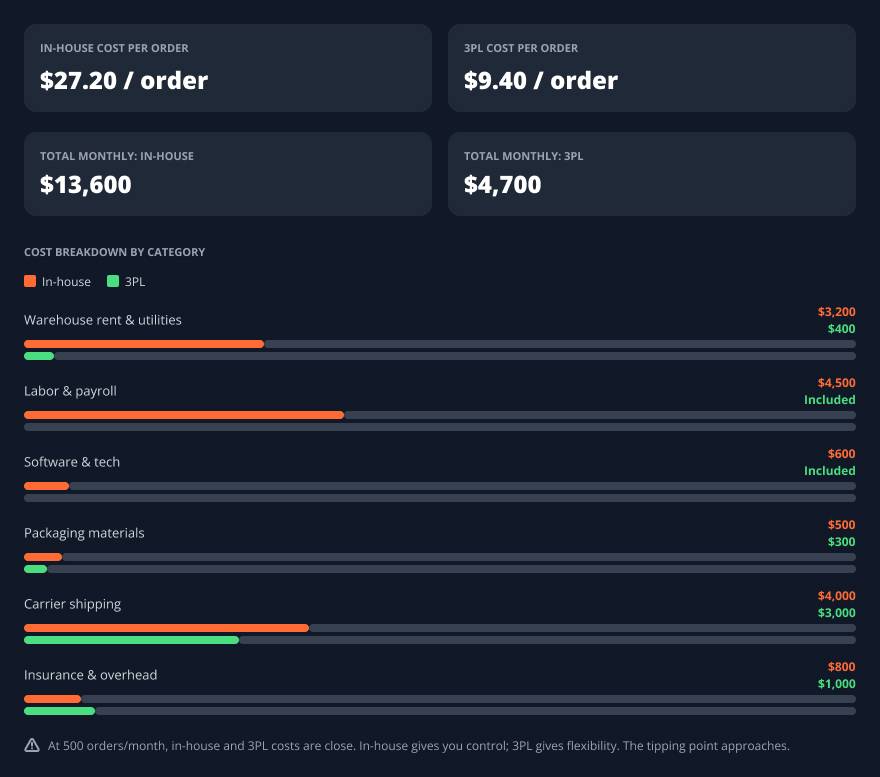
Important note on cost: Outsourcing is not universally cheaper. It depends heavily on order volume. At fewer than 500 monthly orders, in-house fulfillment is typically more cost-effective. Between 500 and 1,000 monthly orders, costs converge. Above 1,000 monthly orders, 3PL economies of scale, discounted carrier rates, shared warehouse infrastructure, and operational efficiency generally make outsourcing financially superior for most product types.
Do you think you are overpaying? Let us make it easier for you to work it out.
The following numbers are here so you can understand the difference.
6. So What Do Brands Get When They Switch?
- No warehouse lease and fixed overhead - Pay only for the storage space your inventory actually uses per pallet, per bin, or per month. No long-term lease, equipment purchases, or utility bills.
- Carrier discounts you can't get alone - Shipmor's consolidated shipping volume unlocks negotiated USPS, UPS, FedEx, DHL, and OnTrac rates, typically 5-40% below retail carrier pricing.
- Fewer shipping zones and faster delivery - With 20 warehouses across 7 states, Shipmor distributes inventory closer to customers, reducing last-mile cost and supporting 2-day ground delivery across the continental US.
- Scales with your order volume - Whether you are at 500 orders a month or 10,000, Shipmor's infrastructure scales with demand and peak-season spikes without requiring you to hire, train, or manage warehouse staff.
- Direct integrations with your platforms - Shipmor connects with Amazon, eBay, Wayfair, Walmart, and ShipStation, with real-time inventory visibility, order tracking, and cost-per-order reporting.
- Returns handled end to end - Shipmor manages reverse logistics, including receiving, inspecting, and restocking returned inventory, so your team does not carry the operational burden.
Do you believe you are spending too much on fulfillment? Then get a free cost analysis. No catch. No strings attached. Tell us about your current setup and we'll show you exactly what outsourcing to Shipmor would cost - line by line.
Ready to simplify your fulfillment?
Let Shipmor handle your logistics while you focus on growing your brand.